
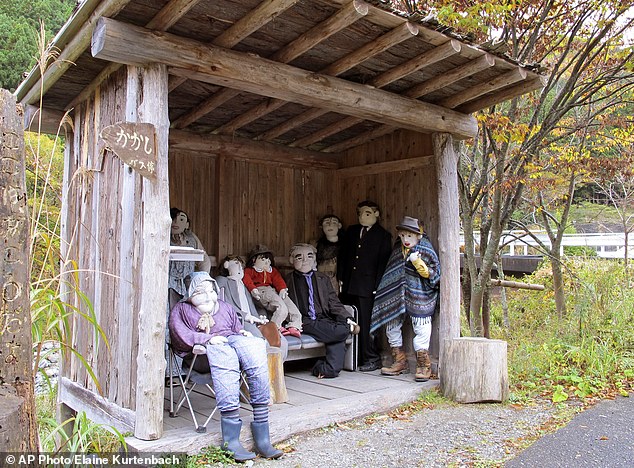
The 35 residents left in Nagoro, southern Japan, are now outnumbered three-two-one by the mannequins Tsukimi Ayano has made to replace neighbours who have died or moved away.
It's an eccentric response to an increasingly common problem. More than 10,000 towns and villages in Japan are depopulated, homes and infrastructure crumbling as the countryside empties.
At 65, Ms Tsukimi is one of the younger residents of Nagoro, a small village nestled in the rugged mountain landscape of interior of the southern island of Shikoku.
She moved back from Osaka to look after her 85-year-old father after decades away.
'They bring back memories,' Ms Tsukimi said of the life-size dolls crowded into corners of her farmhouse, perched on fences and trees, huddled side-by-side at a produce stall, the bus stop - anywhere a living person might stop.
'That old lady used to come and chat and drink tea. That old man used to love to drink sake and tell stories. It reminds me of the old times, when they were still alive and well,' she said.
Nagoro is typical of the thousands of communities turning into ghost towns or at best, open-air museums, frozen in time - a trend evident even in downtown Tokyo and in nearly or completely empty villages in the city's suburbs.
The one-street town is mostly abandoned, its shops and homes permanently shuttered.
With no youngsters left to raise, the local elementary school closed two years ago. Now Ms Tsukimi sometimes guides visitors through the spotless classrooms populated with scarecrow students and teachers.
As Japan grew increasingly affluent after the Second World War, younger Japanese abandoned the countryside, flooding into the cities for jobs in factories and service industries, leaving their elders to tend small farms.
Greater Tokyo, with more than 37million people, and Osaka-Kobe, with 11.5million, account for nearly 40 per cent of the country's 127million people, with another 10million scattered in a handful of provincial capitals.
'There's been this huge sucking sound as the countryside is emptied,' said Joel Cohen, a professor at Columbia University's Laboratory of Populations.
Meanwhile, a falling birthrate means there are too few people to repopulate rural areas as the rapidly ageing population left tending the fields die off.
Japan's population began to decline in 2010 from a peak of 128 million. Without a drastic increase in the birthrate or a loosening of the staunch Japanese resistance to immigration, it is forecast to fall to about 108 million by 2050 and to 87 million by 2060.
By then, four in 10 Japanese will be over 65 years old.
When Ms Tsukimi returned to her hometown 13 years ago, she initially tried farming. Thinking her radish seeds may have been eaten by crows, she decided to make some scarecrows.
Now there are more 100 scattered around Nagoro and other towns in Shikoku.
Like handcarved Buddhist sculptures, each has its own whimsical expression. Some sleep, their eyelids permanently shut. Others cuddle toddler scarecrows, or man ploughs and hoes.
Ms Tsukimi brings one along for company on her 90-minute drive to buy groceries in the nearest big town. But most remain behind, to be photographed and marvelled at by tourists who detour through the winding mountain roads.
'If I hadn't made these scarecrows, people would just drive right by,' she said.
Source

No comments:
Post a Comment