
The Blog For Paranormal Happenings and News
Saturday, April 28, 2012

What happens to your body after you die?
When you die your body immediately begins to change. Depending on how you die and your wishes, the US Government Mortuary Service will prepare your body for internment. Stacy Holmstedt has been fascinated by this topic for years and she shares her obsession quite gently in this week's talk. This work is licensed under a Creative Commons Attribution-Share Alike 3.0 United States License.
The Last Winter (2006) - Full Movie
Mother nature turns against man in a frightening way in Larry Fessenden's innovative shocker "The Last Winter".
Death of Spy, Zipped Into Bag, Spawns Theories and Inquest

An inquest held just across the Thames from MI6’s headquarters here has brought forth details of the bizarre and lonely death in August 2010 of Gareth Williams, a 31-year-old rising star in supersecret counterterrorism work. He was found in a fetal position, arms crossed on his chest, locked inside a duffel bag resting in an unfilled bathtub at the government flat assigned to him in the upscale Pimlico district of London.
His naked body had been in the bag for a week before it was discovered, so badly decomposed that the police and pathologists have been unable to determine whether he was murdered in what his family’s lawyer has suggested to the court was a plot by others skilled in the “dark arts” of spy work.
That theory has played prominently here, with Mr. Williams depicted alternately as a victim of Russian secret service hit men, extremists with Al Qaeda, or a multitude of other potential assassins working in the murky world of espionage who poisoned him with potassium cyanide or an overdose of a powerful sedative drug, GHB, a theory pathologists said could not be effectively tested because of the advanced decomposition.
Photographer sued for breaking priceless artifact during photo shoot


MANHATTAN (CN) - Magazine photographers dropped a collector's 2,600-year-old terracotta statue while moving it for a shot, smashing the $300,000 piece of Nigerian Nok art for good, the collector says in court.
Corice Amran sued Louise Blouin Media in New York County Supreme Court.
Amran says the defendant contacted her in spring 2011 and asked to photograph her ancient Nok sculpture for Art+Auction magazine, which is published by Louise Blouin Media.
Nok has been described as the oldest known figurative sculpture south of the Sahara, according to the Metropolitan Museum of Art.
In May 2011, Amran says, photographers and their assistants arrived at her house for the photo shoot and moved the Nok to the opposite side of the room.
"During the photographers' move of the Nok figure, the Nok figure fell onto the floor and was smashed into a myriad of pieces, cannot be restored and is a total loss," the complaint states.
Court exhibits show pictures of the figurine before and after it was smashed.
"Defendant, through the photographers, acted negligently and without the due care necessary with respect to the Nok figure, particularly in light of its rarity, value and fragility.
"As the result of defendant's negligence, the 2,630-year-old Nok figure owned by plaintiff was destroyed," the complaint states.
Amran seeks $300,000 in compensatory damages for negligence.
She is represented by Charles Rosenzweig with Rand Rosenzweig Radley & Gordon.
[courthousenews.com]
Lung Cancer May Have Been Fruit Pit Inhaled In 1984

Lung cancer is always the pits, but sometimes the pit isn't lung cancer.
Florida woman Blanca Riveron, 62, was horrified to hear that she may have cancer when doctors found a dark spot on her lung in December, WTSP reported.
Before the bad news, she'd spent 28 years coughing, wheezing, and sitting in hospital beds with bouts of asthma and pneumonia.
A few weeks later, the Seminole Heights woman was sitting at a traffic light when one of her violent coughing fits struck. This time, however, she coughed up a fruit pit. It turns out that the fruit pit was likely the "spot" found on her lung.
West Virginia Spectral Heritage Project created to study ghost history

An employee died after falling from the elevator shaft of the downtown library during maintenance. Students over the years have reported seeing him get on the elevator late at night and vanish before they get to a chance to catch him.
Even a ghostly cow moos in Woodburn, after a senior prank went wrong and lead the cow to its death in the clock tower.
Stories like these are what motivated Jason Burns, WVU professor and storyteller, to create the West Virginia Spectral Heritage Project.
The project was founded in 2006 and helps keep the history-rich ghost stories of the state alive.
But, West Virginian ghostly tales are nothing new.
Deadly Fungus Has Killed 200 Amphibian Species Since 2004

Sam Scheiner, NSF program officer for Ecology and Evolution of Infectious Diseases says, “Wildlife diseases can be just as devastating to our health and economy as agricultural and human diseases. Bd has been decimating frog and salamander species worldwide, which may fundamentally disrupt natural systems. This study is an important advance in our understanding of the disease, a first step in finding a way to reduce its effects.”
The scientists say, aquatic fungus Batrachochytrium dendrobatidis (Bd), disrupts fluid and the electrolyte balance in wild frogs which severely depletes the frogs’ sodium and potassium levels and causing cardiac arrest
The chytrid fungus attacks an amphibian’s skin, causing it to become up to 40 times thicker. Since frogs depend on their skin to absorb water and electrolytes like sodium from their environment, UC Berkeley ecologist Jamie Voyles, the lead author of the study and her colleagues knew that chytrid would disrupt fluid balance in the infected amphibians.
TSA Screeners Arrested in Drug Trafficking Scheme
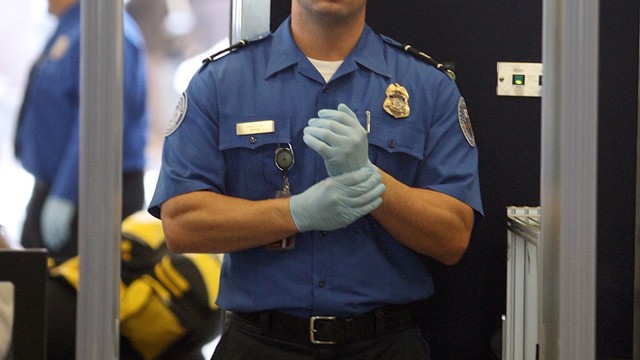
The four accepted cash to allow large shipments of cocaine, methamphetamine and marijuana through X-ray machines, the US justice department said.
The charges allege 22 separate payments of up to $2,400 (£1,500) allowed drug-runners to bypass airport security.
A prosecutor said they "placed greed above the nation's security needs".
"The allegations in this case describe a significant breakdown of the screening system," Andre Birotte said.
Shadow Government: TSA agents harass 7-year-old girl with cerebral palsy and developmental disability

Traveling from New York’s John F. Kennedy International Airport to Florida, the Frank family was yanked out of line as it boarded the plane in a dispute over how 7-year-old Dina had been screened. The little girl, who has cerebral palsy, walks with crutches and leg braces.
“They make our lives completely difficult,” said her father, Dr. Joshua Frank, a Long Island pediatrician. “She’s not a threat to national security.”
Flying is always difficult for the family, but this week was particularly dreadful, Frank and his wife, Marcy, said.
With her crutches and orthotics, Dina cannot walk through metal detectors and instead is patted down by security agents. The girl, who is also developmentally disabled, is often frightened by the procedure, her father said.
The quantum future is crystal clear: Tiny crystal revolutionises computing
The quantum future is crystal clear: Tiny crystal revolutionizes computing
Computing technology has taken a huge leap forward thanks to a tiny crystal of trapped ions used in experiments by Dr Michael Biercuk, from the University of Sydney's School of Physics and ARC Centre of Excellence for Engineered Quantum Systems, with US and South African colleagues.
The ion-crystal is poised to become one of the most powerful computers yet developed, with the results published in the prestigious journal Nature on 26 April 2012.
Subscribe to:
Posts (Atom)