Wednesday, February 8, 2012

Dark Places: Aokigahara Suicide Forest


Bordering the famed Mount Fuji in Japan is a dark, sinister forest known as Aokigahara, or “The Sea of Trees.” Although from the outside it looks like your typical, run-of-the-mill forest, the inside is an entirely different story.

Also known as the Sea of Trees, Aokigahara is a vast 35 kmforest on the largest island of Japan that is widely believed to be one of the most haunted places in the world. It is the second most popular suicide destination after the Golden Gate Bridge in San Francisco, and is renowned as being “the perfect place to die”. Due to the wind-blocking density of the trees and the surprising lack of wildlife, the forest has a reputation for being eerily quiet. Over 500 people have killed themselves since the 1950′s. That’s a conservative estimate since authorities can only get a body count by stumbling upon corpses. It’s widely assumed that the trend was started after the publication of Seicho Matsumoto’s novel “Kuroi Kaiju” (Black Sea of Trees) in which 2 lovers commit suicide in the forest.

Miyuki Ishikawa was reputed to have stayed there, deep in the forest in the mid 1950s, before eventually making her way to Thailand and later on to Lousiana to what has eventually become known as the The Stuart House hauntings.

The government has taken several steps to cut down on rates of suicide in the forest, even going so far as to post numerous signs encouraging people to get psychiatric help. The signs seem to have had little effect and in 2002, authorities discovered 78 corpses. In 2003 there were 100 corpses found and the number has since peaked at 108 in 2004. Who knows how many bodies they miss each year? There’s even a group of people who make their living by scavenging money and jewelry from the dead.

Spiritualists believe that the emotions and life energy of all the people who’ve died in the forest have been infused into the trees and permeate all of Aokigahara. According to them, this generates paranormal activity and has many detrimental effects on those who enter the forest. It’s also easy to get lost due to the large number of iron deposits in the volcanic soil, which renders compasses useless because of magnetic interference.

The massive size of the forest, combined with little to no human habitation means that the desperate souls who enter the Sea of Trees are unlikely to be rescued or found once they kill themselves.
The increase in suicides has been linked to Japan’s economic difficulties in recent decades. The practice of suicide also predates Matsumoto’s novel, with ubasute being practiced well into the 19th century. “Ubasute” was the abandonment of the elderly and infirm on mountains or in forests where they were left to die of starvation, dehydration or exposure. It was allegedly practiced primarily during famines and droughts but there is no definitive proof that this was widely practiced in the region. 

Several Japanese parapsychologists say that there is something that walks the forest, something best left alone .Regardless of whether it’s true or not, there are many who believe in the haunting of Aokigahara. 

Aokigahara1 e1263864786405 Aokigahara (aka Suicide Forest) picture
Aokigahara is the perfect place to set a horror movie, as it has become the second most popular location (the Golden Gate Bridge is currently ranked number one) for wary travelers to shuffle off this mortal coil by their own hands.
The forest has become so legendary as a prime suicide location that several signs have been erected and drilled into the trees pleading with travelers to reconsider making the Sea of Trees their final resting place. Others who choose to explore the supposedly haunted forest simply for the thrill of it may run the risk of coming across some of the many corpses there that have yet to be discovered.
Its haunted reputation stems not just from its sinister nature but from the legends that surround suicides in Japanese mythology. According to Japanese lore, those who leave this earth in a way deemed unnatural are doomed to remain on earth as wandering specters.
When a body is found, it is placed in a bed at a forestry station located nearby, next to an empty one for a loved one. Japanese lore states that the spirit, known as a yurei, will howl and scream into the night if left alone throughout the night.
Aokigahara2 e1263864831912 Aokigahara (aka Suicide Forest) picture
The forest is mentioned in Wataru Tsurumui’s book The Manual of Suicides, and was even the subject of the 2004 movie Jyukai — The Sea of Trees Behind Mt. Fuji. Bodies are still being found there, often hanging from the trees and in varying states of decomposition. Many of those who venture into the sinister forest due to curiosity and not thoughts of ending it all can often stumble across skeletal remains and personal items, such as credit cards, wallets and rail passes.

!!!WARNING: GRAPHIC IMAGES!!!

Yurei: Famous Hauntings

Yūrei (幽霊) are figures in Japanese folklore, analogous to Western legends of ghosts. The name consists of two kanji, 幽 (yū), meaning "faint" or "dim" and 霊 (rei), meaning "soul" or "spirit." Alternative names include 亡霊 (Bōrei) meaning ruined or departed spirit, 死霊 (Shiryō) meaning dead spirit, or the more encompassing 妖怪 (Yōkai) or お化け (Obake).

Like their Chinese and Western counterparts, they are thought to be spirits kept from a peaceful afterlife. Yūrei do not wander at random, but generally stay near a specific location, such as where they were killed or where their body lies, or follow a specific person, such as their murderer, or a beloved. They usually appear between 2 and 3 a.m, the witching hour for Japan, when the veils between the world of the dead and the world of the living are at their thinnest.

Yūrei will continue to haunt that particular person or place until their purpose is fulfilled, and they can move on to the afterlife. However, some particularly strong yūrei, specifically onryō who are consumed by vengeance, continue to haunt long after their killers have been brought to justice.

Some famous locations that are said to be haunted by yūrei are the well of Himeji Castle, haunted by the ghost of Okiku, and Aokigahara, the forest at the bottom of Mt. Fuji, which is a popular location for suicide. A particularly powerful onryō, Oiwa, is said to be able to bring vengeance on any actress portraying her part in a theater or film adaptation.
Aokigahara -Forest Of Suicides

Well of Himeji Castle

Occult Orders: Opus Dei and Corporal Mortification

The Da Vinci Code has drawn attention to the Catholic custom of corporal mortification. Rev. Michael Barrett, a priest of Opus Dei, answers questions.

Opus Dei - Fr. Mike Barrett, director of the Holy Cross Chapel and Catholic Resource Center, Houston, Texas.
Fr. Mike Barrett, director of the Holy Cross Chapel and Catholic Resource Center, Houston, Texas.
Is The Da Vinci Code's portayal of corporal mortification accurate?

The Da Vinci Code's bloody depictions of mortification are grotesque exaggerations that have nothing to do with reality. Obviously the movie makers were looking for shock value, and the real use of the cilice and discipline would have been too tame. In reality, they cause a fairly low level of discomfort comparable to fasting. There is no blood, no injury, nothing to harm a person's health, nothing traumatic. If it caused any harm, the Church would not allow it.

Do members of Opus Dei use the cilice?

Some of the celibate members of Opus Dei use the cilice. It's a small, light, metal chain with little prongs worn around the thigh. The cilice is uncomfortable--it's supposed to be--but it does not in any way hinder one's normal activities and there's absolutely no Da Vinci Code gore.

Occult Orders: Rick Santorum Member of Opus Dei?


rick-santorum-questions
Who does this guy really work for?
In the tiny town of Riva del Garda in northern Italy, 83-year-old-Maria Malacarne Santorum keeps her family’s secrets—including those of her late husband’s cousin, Rick. In an exclusive interview with the Italian weekly magazine Oggi, Mrs. Santorum recalls fondly when Rick visited her in 1985 during his law internship in Florence and when he came back again in 1986 and 1989.
“He loved our culture and cuisine so much, he brought his wife-to-be, Karen, a massive cookbook of Italian recipes,” she said.
The elder Santorum matriarch doesn’t understand why he has diverged so far from the family’s longtime political stance. “In Riva del Garda his grandfather Pietro and uncles were ‘red communists’ to the core,” writes Oggi journalist Giuseppe Fumagalli, likening the family to “Peppone” after a famous fictional Italian communist mayor who fought against an ultraconservative priest known as Don Cammillo and about which a popular television series is based. “But on the other side of the ocean, it’s like his family here doesn’t exist. Instead he draws crowds as the head of the ultraconservative faction of the Republican party, against divorce, gay marriage, abortion, and immigration.”

Vostok Lake Update : Antarctic lake success 'uncertain'

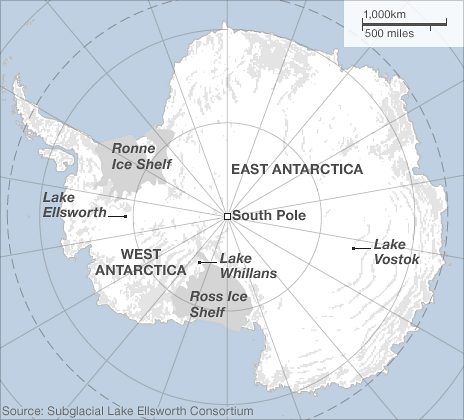
Lake Vostok SPL Vostok is the largest of several bodies of water buried under the Antarctic ice

Related Stories

It is not yet clear whether Russian scientists have succeeded in their quest to drill into Lake Vostok.
National media on Monday reported a breakthrough into the lake, the largest of more than 300 bodies of liquid water buried under Antarctica's ice.
But Valery Lukin, the Russian Antarctic programme director, has told Nature journal that the claim is premature.
He said data from a number of sensors monitoring the drilling had yet to be analysed.
"Only when I will have this I can say we penetrated [the lake]," Nature quoted him as saying. "We want to be sure we have really reached the surface of Lake Vostok."
Russian, British and US researchers are in a race to see who will be first to reach down into the waters of an Antarctic subglacial lake.
These bodies of water have been sealed off from the atmosphere for millions of years and so may contain life forms new to science.
The Russians have been leading the way with their drilling project in the east of the White Continent.
According to Russia's Arctic and Antarctic Research Institute in St Petersburg, the team began drilling on 2 January and had been progressing by about 1.75m (5.7ft) per day.
On 12 January, the team halted activity to take measurements and to switch drills from a large ice-coring drill to a smaller thermal drill designed to melt through the final five to 10m (16 to 32ft) of ice.
Lake Vostok, which is about the same size as Lake Ontario, is buried beneath nearly 4km of ice. The lake itself is about the same age as the ice that covers it - 14 million years old.
The Russians have friendly competition from US and British teams. Researchers from the British Antarctic Survey (Bas) are hoping to begin their project to drill into Lake Ellsworth in Antarctica later this year. An American crew is targeting Lake Whillans.
BBC News